
Alcohol-regulated promoters
Scientific aspects
The promoter system in its natural environment
In a bacterial positive-mode operon or positive operon the genes are off by default and are turned on by activators. The interaction between a regulatory protein and a regulatory region on the DNA to which it binds turns transcription on.
The ethanol utilization pathway of the filamentous fungus Aspergillus nidulans is a well-characterized positive operon system. It controls the cellular response to ethanol and other related chemicals. The first enzyme in the pathway of ethanol utilization is alcohol dehydrogenase I (Adh-I) encoded by the alcA gene. The transcriptional activator protein AlcRbinds target sequences within the alcA gene promoter in the presence of ethanol, ethyl methyl ketone or other alcohols/ketones. These compounds act as inducers of the gene expression.
A promoter system transferred into plants
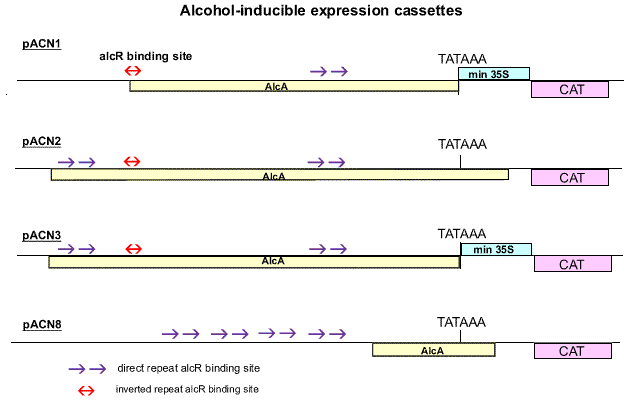
One system transferred into plants provides the alcR gene under the control of a strong constitutive promtoer such as CaMV 35S, and a modfied alcA promoter linked to a gene of interest or target gene. The modified or chimeric alcA promoter (referred to as the target promoter) comprises the regulatory sequence of the alcA promoter which is bound by AlcR and a core promoter region (a TATA box and a transcription start site) of a plant-expressible gene promoter. In the presence of an inducer (e.g., an alcohol or ketone), the transactivator protein AlcR binds to the specific sequences of the modified alcA promoter and the target gene is expressed.
Among the advantages of the system are:
- the lack of an equivalent alcR gene in plants, which rules out interference with plant endogenous Adh activity,
- the chemical inducers are relatively simple molecules with low toxicity, and
- under normal growth conditions of a plant, the levels of natural inducers, (e.g., ethanol) that are produced when plants are waterlogged or under artificial anoxia are very low and do not induce alcA expression.
The alcohol-inducible system can be used for:
- production of high levels of recombinant proteins, especially those that interfere with growth or biomass production,
- providing an inducible male sterility system, and
- providing inducible expression of resistance genes.
Nevertheless, there are still some difficulties in using the system for agricultural purposes. Specifically, the means to introduce the inducer, e.g., by spraying or drenching, and its volatility, impact the effectiveness of the system for field work.
IP issues
Syngenta has patents related to alcohol-inducible expression systems for plants. Its patents were granted in United States and Europe.
Approximate scope of protection
The only patent grant is in Europe. The patent claims:
- a chemically-inducible plant gene expression cassette that contains:
- a promoter linked to an AlcR encoding gene, and
- an inducible promoter linked to a gene of interest.
- a method for controlling plant gene expression by using the mentioned expression cassette, and
- a chimeric chemically-inducible promoter containing:
- regulatory sequences of the alcA gene promoter, and
- a transcription initiation sequence from a plant-expressible gene promoter.
Note that the inducible promoter of the expression cassette is not restricted to any particular promoter and may be other than alcA (claim 1). The promoter is activatable by the regulatory protein (AlcR protein) in the presence of an effective inducer. The inducible promoter may be derived from aldehyde dehydrogenase gene or other alcohol dehydrogenase genes that are involved in the ethanol utilization pathway.
The transcription initiation sequence of the chimeric chemically-inducible promoter refers to the CAAT box, TATA box and surrounding sequences that define the transcription start point for the structural gene.
Specific Patent Information
| Patent Number | Title, Summary of Claims and Independent Claims | Assignee | |||
|---|---|---|---|---|---|
EP 637339 B1
|
Title – DNA constructs and plants incorporating them
The claims are generally to:
|
Syngenta Ltd. |
|||
US 6605754
|
Title – DNA constructs and plants incorporating them
The claims of this US patent is genearlly directed to:
|
||||
|
Remarks |
The application in Australia (AU 39019/93 A1) has lapsed. |
Note: Patent information was last updated on 11 May 2006. Search terms: “promoter” in abstract and “Syngenta” in application. Patent database: PatentLens in combination with INPADOC.