
Tetracycline-regulated promoters
Scientific aspects
Transposons are mobile genetic elements which can insert at random into plasmids or a bacterial chromosome independently of the host cell recombination system. Transposons carry genes that confer new phenotypes on the host cell such as antibiotic resistance.
The Tetracycline resistance operon is carried by the Escherichia coli transposon (Tn) 10. This operon has a negative mode of operation. The interaction between a repressor protein encoded by the operon,TetR, and a DNA sequence to which it binds, the tet operator (tetO), represses the activity of a promoter placed near the operator. In the absence of an inducer,TetR binds to tetO and prevents transcription. Transcription can be turned on when an inducer, such as tetracycline, binds to TetR and causes a conformation change that prevents TetR from remaining bound to the operator. When the operator site is not bound, the activity of the promoter is restored.
In plants, the system has been adapted in two ways
- as a promoter repressing system, basically using the system as described, and
- as a promoter activating system, where TetR is modified to activate gene transcription, instead of inhibiting transcription.
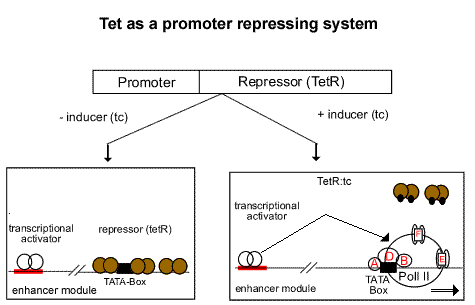
In one system, a CaMV 35S promoter is modified by introducing a tet operator sequence upstream and downstream of the TATA box. In the absence of tetracycline, overexpressed TetR binds to the tet operator and prevents gene expression. In the presence of tetracycline, TetR no longer binds the operator and gene expression is turned on.
In tobacco, the expression of the tetracycline-inducible CaMV promoter could be modulated up to 500-fold. This inducible promoter has also worked in tomato and potato.
Unfortunately, the system presents some problems. For tetracycline to work as an inducer, it must be supplied continuously to the medium due in part to the short-half life of the antibiotic. In addition, TetR must be in high concentration to be effective as a repressor as it has to compete with at least forty proteins that assemble around the TATA box. For some plants, such as Arabidopsis, high concentrations of the repressor are toxic and alter the photosynthetic physiology of the plant.
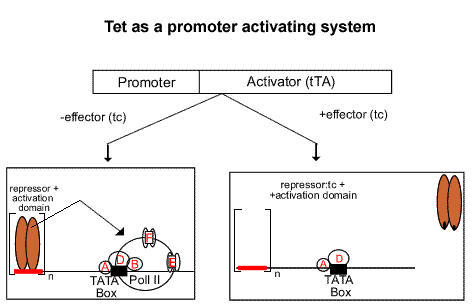
Due to the drawbacks of the promoter repressing system, TetR has also been converted to an activator of gene expression. In one version of a promoter activating system, TetR is fused to the acidic activation sequence of the herpes simplex virus protein 16 (VP16), forming a tetracycline transactivator (tTA) fusion protein which is has the DNA binding specificity of TetR and the promoter activating function of VP16. In the absence of tetracycline, tTA binds to tet operator sequences placed upstream of a TATA box in a target promoter and activates transcription. When tetracycline is provided, it forms a complex with tTA and releases the operator, thus, turning off gene transcription.
In contrast to the wild type TetR, tTA does not need to compete with endogenous transcription factors for binding sites. The system has worked in tobacco and in Arabidopsis.
Despite the advantages of the Tet activating system, the plants must be in the presence of tetracycline to turn transcription off. That implies a continuous supply of the antibiotic. Also the original promoter that contains the tet operators is prone to silencing over time. Work has been done to improve the efficacy of the promoter.
IP issues
Yale University and BASF AG have several patents and patent applications related to tetracycline-regulated promoter systems. The inventions claimed by these institutes include the use of a wild-type TetR and fusion proteins formed by a wild type TetR or a mutated TetR linked to either an activator or an inhibitor of transcription.
1. Yale University patents
Yale has a United States patent and a European patent directed to an auto-regulated tetracycline transactivator tTA placed under the control of a minimal promoter having at least onetetO sequence.
 The inventions
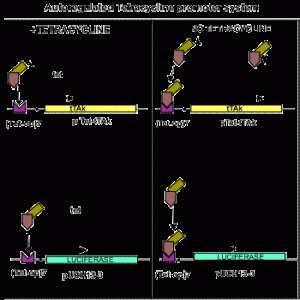
In the United States patent US 5851796 and the European patent EP 832254 B1, the production of tTA is regulated by the presence of tetracycline: in its presence, tTA is not produced. In the absence of tetracycline, tTA binds the tetO sequence promoting the expression of the gene(s) under the control of an inducible promoter.
Claims are drawn to:
A polynucleotide:
- encoding a tetracycline transactivator fusion protein and
- operably linked to an inducible minimal promtoer with at least one tetO sequence
The United States patent describes that a gene that’s operably linked to a promoter sequence is placed under the control of that sequence.
The encoded protein contains:
- a prokaryotic tet repressor (the claim is not limited to only the DNA binding portion) and a
- eukaryotic transcriptional activator protein (the activator is not limited to the VP16 activator).
Although the patent describes that different activator sequences can be used (listing acidic rich domains such as in VP16, proline rich domains of CTF/NF-1, serine/threonine rich domains of Oct-2, or glutamine rich domains, such as found in Sp1), the only construct tested is one in which the activator is VP16.
The specification describes that a “eukaryotic transcriptional activator” is capable of activating transcription in eukaryotes.
Methods for decreasing or enhancing the expression of a heterologous protein in a eukaryotic cell are also claimed. The methods generally include inserting two DNA molecules into the cell: One of them is the polynucleotide described above.; the other encodes a heterologous protein to be regulated by the system linked to a minimal promoter, which also has at least a tetO sequence. When the transformed eukaryotic cell is cultivated in the presence of tetracycline or a tetracycline analogue, the expression of the heterologous protein is inhibited because the activator tTA does not remain bound to the minimal promoter having the tetO sequence that drives the expression of the heterologous gene. Conversely, in the absence of tetracycline, the heterologous protein is expressed in the eukaryotic cell because the tTA activator remains bound
The specification defines “heterologous” as is a protein that does not naturally occur in the specific host organism in which it is present.
Kits containing the two types of molecules used in the method are also claimed. However, the kits have to have:
- at least two container means each containing a different one of the two molecules;
- the means have to be in close confinement in the kit.
An additional kit claim requires that:
- the mentioned polynucleotide encoding the transactivator fusion protein is within a eukaryotic cell.
The patent does not describe what a “container means” is or how close “close confinement” has to be.
The specific patent information of US 5851796 and EP 832254 B1 is presented in the following table. For more information about licencing etc., the Yale Office of Cooperative Research shoud be contacted.
|
Patent number |
Title, Independent Claims and Summary of Claims |
Assignee |
||||||
|---|---|---|---|---|---|---|---|---|
US 5851796
|
Title – Autoregulatory tetracycline-regulated system for inducible gene expression in eucaryotes
|
Yale University |
||||||
EP 832254 B1
|
Title – Autoregulatory tetracycline-regulated system for inducible gene expression in eucaryotes
The independent claims are similar to the claims of US 5851796, except for the metioning of the 5′ end modification of the open reading frame of the polynucleotide molecule encoding the tetracycline transactivator fusion protein and the claims for the composition of matter consisting essentially of the plasmids pTet-Splice and pTet-tTAK. |
|||||||
|
Remarks |
The application filed in Australia (AU 62745/96) has lapsed. Related application also filed in Japan (JP 11507539 T2). |
Note: Patent information on this page was last updated on 15 March 2006. Search terms: “tetracycline” in abstract and “Yale University” in applicant. Patent database: PatentLens in combination with INPADOC.